
Ditching their scripts - Margot Escott transforms Parkinson’s patients with improv
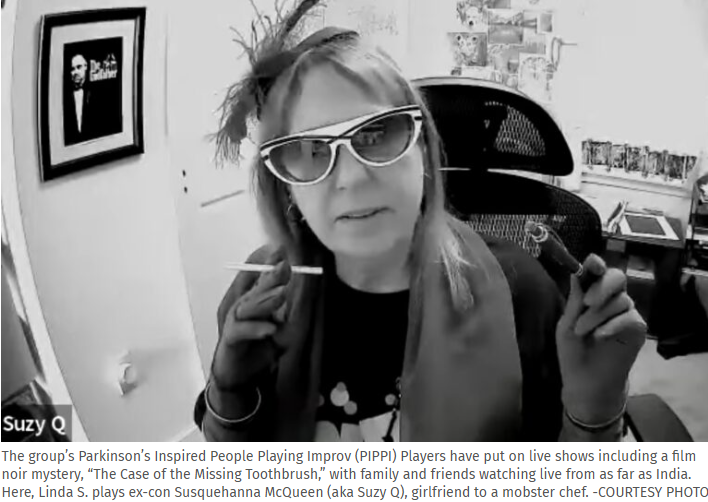
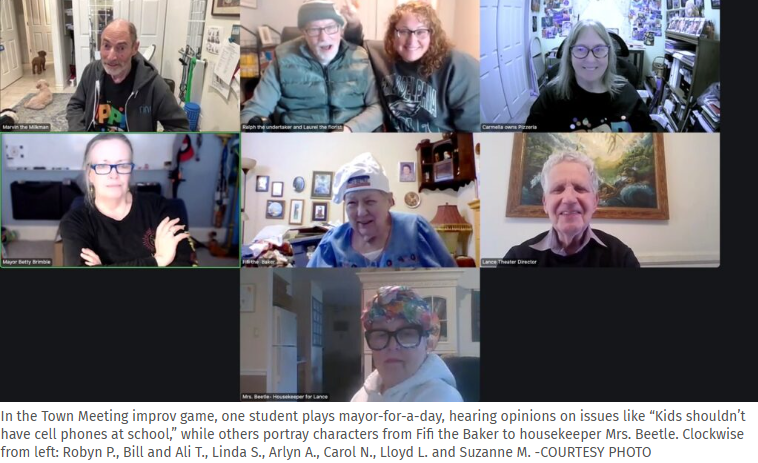
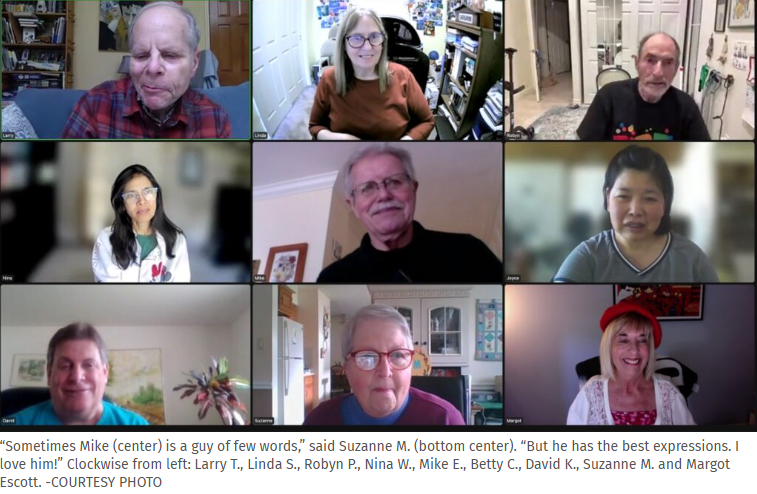
At first, it looks like a Hollywood Squares-style pandemic Zoom meeting: talking heads on blurred or artfully arrayed backgrounds, jammie pants from the waist down.
MEDIA
5/1/20266 min read
At first, it looks like a Hollywood Squares-style pandemic Zoom meeting: talking heads on blurred or artfully arrayed backgrounds, jammie pants from the waist down.
There the similarity ends. Except maybe the jammies.
The folks in this Zoom rogues’ gallery alternately clench their fists, snarl like lions, mimic alien antennae, split their faces wide with grimaces and, mostly, laugh their heads off.
You might see caregivers quietly going about their business in the background, pausing to give a kiss or wave goodbye on their way out the door. Sometimes they take part in the call themselves.
In the foreground: clinical psychotherapist Margot Escott and a checkerboard of Parkinson’s patients are having a blast together for 90 minutes every week. Group therapy has never looked so zany.
Throughout her more than 40 years as a Naples-based clinician, Escott has sworn by laughter and game playing as medicine.
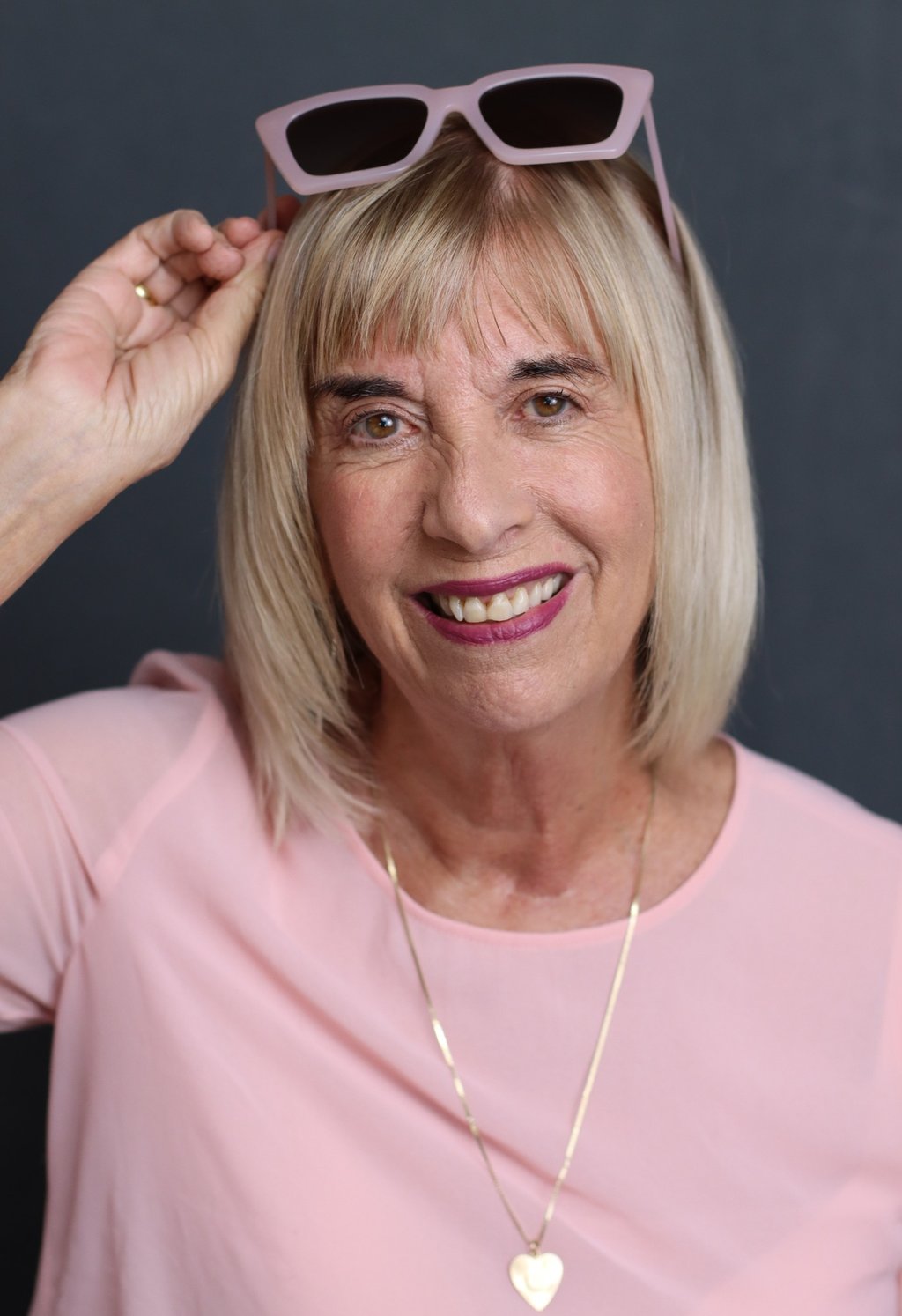
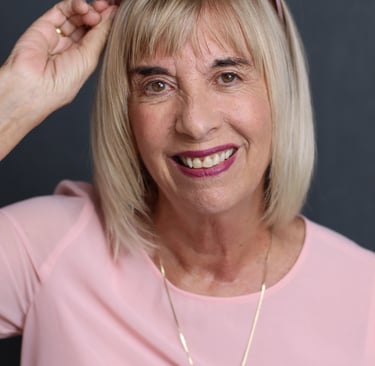
Margot Escott: Laughing all the way to health
“Around 1977, way before I became an MSW,” she recalled, “I took a weekend training to be a referee in something called New Games, which were very much like the improv games I learned 20 to 30 years later.”
For over 30 years Escott presented nationwide workshops and seminars on the “Therapeutic Value of Humor and Play” and published several articles on humor, geriatric issues and improvisational comedy.
She was clearly onto something, because research shows that laughter produces endorphins and releases the “feel-good” neurotransmitter dopamine in the brains of patients whose dopamine levels are depleted, as in Parkinson’s disease.
But the therapy of humor suddenly became personal for her when, in 1998, her father was diagnosed with a severe form of Parkinson’s.
She’d just become involved in her local chapter of the Parkinson’s Association of Southwest Florida and was asked to speak at one of their first meetings, on “Healing Power of Laughter & Play.” One week later, her dad, Ivan Escott Jr., was diagnosed with Parkinson’s.
“He was always funny and had a good sense of humor,” Margot said. “And for the last five years of his life, my husband and I took care of him.”
As a clinician she became fascinated with the incurable neurological disorder and began working with Parkinson’s clients and their care partners. When she later began studying improvisational theatre, something clicked.
“I immediately recognized the therapeutic benefits of improv,” she said. “I thought I was unique, until I discovered the work of Dr. Daniel Wiener, who wrote the first book on using improvisational theatre in clinical practice: Rehearsals for Growth (RfG). I studied with him and became certified as an RfG trainer and teacher.”
Since 2010 she has applied improvisational games to therapy for social anxiety, addiction, PTSD and depression, and is considered a pioneer in teaching improv to people with Parkinson’s disease.
The challenges of Parkinson’s
Parkinson’s disease affects nearly 1 million people in the United States, with 90,000 new diagnoses each year, more among males than females. Although medications help treat symptoms, there is no cure.
Due in part to the loss of dopamine-producing brain cells, Parkinson’s disease affects primarily the nervous system, causing progressive movement difficulties including tremors, stiffness and slow walking. It also affects such nonmotor functions as mood, memory and focus.
Patients also suffer from hypophonia, speaking too quietly, and “facial masking,” in which facial expressions become so stiff and slow that others see them as sad, angry or bored.
Anxiety and depression are common byproducts of a disease that shrinks sufferers’ worlds down to the safe boundaries of home and loved ones.
‘Whose line is it anyway?’
If the idea of improvising onstage with others makes your very teeth sweat, just imagine doing it when your speech is painfully slow, your expressions are unreadable, your hands are trembling and you’ve lost confidence in your ability to interact with others, let alone be funny at the drop of a cue.
Nevertheless, in two weekly online Zoom sessions, Margot Escott has transformed a troupe of stage-shy strangers with Parkinson’s disease into their own Second City. They’ve grown to embrace new friends from across the country in a virtual gathering that they anticipate eagerly every week.
Suzanne M., who might show up sporting a pink feather boa or a floral snood, said, “I love seeing Lloyd from California, and Robin from Arizona, and Linda and Larry and Mike, and just seeing how everybody’s doing. There’s always a lot of support for each other if we’re going through something difficult.”
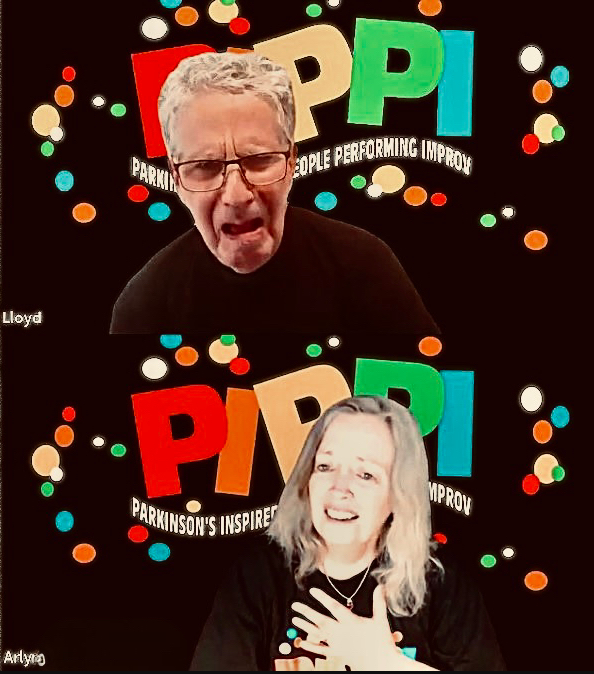
Many students, like Lloyd L., report experiencing anxiety and depression throughout the week, but that improv makes things better with humor, spontaneity and social interaction.
“When I’ve been having a really rough time,” he said, “I get to push it all aside for at least an hour and a half every week, just forget about it and be the old me.”
Lloyd, a bespectacled guy who now lives in Redondo Beach, California, said in a loping Queens drawl, “I’ve been doing comedy for a long time, and I’ve always loved it. But I stayed away from improv for many years because I didn’t think I was spontaneously funny. And I learned I am.
“Getting in a clever line on the spur of the moment is a talent you’re born with but that you can also develop. Luckily, I found a class with other PD improvisers, where I can shake, stammer and blank out to my heart’s content. Every week, Margot Escott uses her extensive improv teaching background to create an amazing class that sharpens our wit, spontaneity and overall cognitive abilities. And most important: It’s fun.”
The first thing, Margot says, is getting over that initial fear of coming to a class. Once students sign in, she reassures them that, in improv, they don’t have to be funny, they just need to have fun, in a social support group that doesn’t talk medications or disease. The main goal is to give students a safe space where they can relax, take a break from everyday concerns and, along the way, rediscover themselves.
“As we say in improv, there are no mistakes,” she said. “If you think you’ve made a mistake, we celebrate it, laugh about it and use it.”
‘Can you hear me now?’
Many of Margot’s improv games address issues specific to Parkinson’s.
There’s been much research on music’s value for Parkinson’s patients, including improved vocal quality, respiratory function and swallowing. Music also has the power to uplift clients who suffer anxiety and depression.
Each class starts with singing games to strengthen the vocal cords and help students project their voices.
To help with facial masking, there’s a musical exercise called Two-Line Freeze, where Margot plays lively pop music and encourages students to make faces and move their hands and arms. At “Freeze!” she picks two students to do a quick two-line scene based on their facial and body expressions.
In gibberish games like Translator, one student speaks in made-up gibberish and the other translates into English. As some students have difficulty speaking, using a “silly” language, even just random sounds, helps them stay engaged and laughing.
From her country-kitchen table, Suzanne said, “It lets you forget your Parkinson’s for a while, but still be with people who understand that sometimes it takes you longer to get your words out, or to get your facial expression working, and it’s a great support.
“It’s stimulating in terms of cognitive function, social interaction, using our facial muscles, really working on expression in a really fun way that’s new and different. With Parkinson’s, anything that stimulates your brain is good for you.”
His crystal-blue eyes twinkling, a smile wreathing his face, Mike E. piped up, “Everything Sue said!”
“Sometimes Mike is a guy of few words,” said Suzanne. “But he has the best expressions. I love him!”
In The KNOW:
Margot Escott, LCSW
Margot Escott LCSW graduated from the New York University School of Social Work in 1983 and has lived and practiced in Naples since 1984. In 1986 she became a Licensed Clinical Social worker in Florida.
Where: Serving the world via 90-minute Zoom improv classes online
When: 2:30 p.m. Wednesdays, 11 a.m. Saturdays
Phone: 239-216-3931
Website: com
Social media: facebook.com/MEscottLCSW/
Contact: margotescott@mac.com
Original Article Page: https://www.floridaweekly.com/articles/naples-ae/ditching-their-scripts/

IMPROV4WELLNESS
© 2024. All rights reserved.
Call me on my confidential line:
(239) 216-3931